
Dad died 20 years ago today. For once, something really does seem like it happened that long ago. Twenty years sounds like a really long time, and it is. A generation. RIP, Dad.


So, all said and done, here's to a new year of grieving and recovery. I'm hoping for good things gradually developing.

I'm in the picture, so this is probably Christmas, 1959
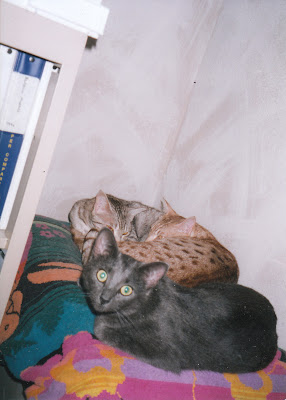
The 3 girls in their youth

Juno

Juno and Selu, sisters, in one last photo


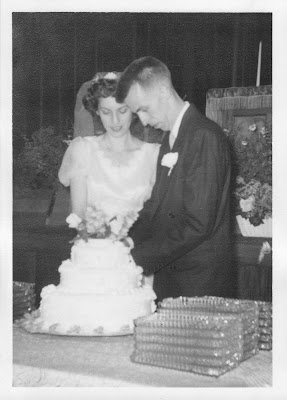
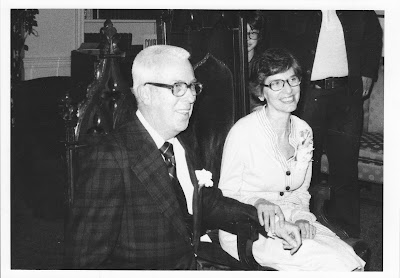
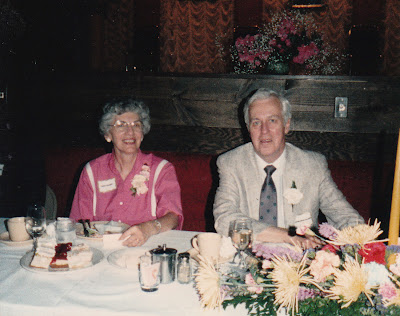

Lobby of Hyatt Regency SF


One thing that struck as we drove and walked around northern California with Karri and Pete was how often I thought of a story about Mom. I finally made myself stop sharing them, they came up so often. Oddly enough, I can't remember now what those stories were. I think some of them probably had to do with family vacations as a kid, but honestly, I'm not sure what to attribute the abundance of Mom-sharing to. Karri was perhaps the most consistent of my friends to call me and see how we were doing with Mom's care while she was with us. But there was more going on than just that.
 Golden Gate Bridge

The truth is, I'm only giving a very abbreviated version of our vacation. When we got home, we took a few more days off, then started working our way back into some sort of routine of work and downtime. I was supposed to go to lunch on the Tuesday after we got back with my friend and colleague, Shelly. Shortly before leaving on our trip, I attended a work-related 'retreat,' and that's when we set the date. Shelly was diagnosed almost exactly a year ago with pancreatic cancer. She had surgery, but was constantly struggling with chemo and radiation. They would start the treatments, and her platelets would go out of whack. So they would stop, and try another dose, combination, whatever. So things like lunch with a friend were a high priority for Shelly, especially since she didn't always know if she would be feeling up to it on any given day.
The day before we were to meet, I sent her an email, asking where she would like to meet. That evening, when I checked my email to see if she had answered, there was an email from a mutual friend and colleague, Ellen, with the subject line "News about Shelly." The email said I should call Ellen. I knew this was not good. I called her. She, too, had just returned from a two-week vacation. She reported that Shelly had been have trouble with a post-surgery stent, and had been in and out of the hospital while we were both gone. The Thursday before, she learned, Shelly became unresponsive. On Sunday, June 13, Shelly died.
Shelly and I were friends, though not in each others' closest circles. And I can't stop thinking about Shelly, and how sad it is that I will never bump into her on campus, and that we'll weren't able to have that last scheduled lunch. Shelly was a great teacher, tough and demanding, and I admired her dedication and the tremendous hard work she put into moving her students to a new level of understanding. And I know that somehow, the grief for Shelly is weighted on top of the grief for Mom, magnifying both.
And I can't stop thinking about the loss, our loss, now that Shelly is gone.

I would like to read from 1 Corinthians 13:
If I speak in the tongues of mortals and of angels, but do not have love, I am a noisy gong or a clanging cymbal.
So I trust that, with love for my mother and my mother’s love for me, my words will be neither a noisy gong or clanging symbol.
And if I have prophetic powers, and understand all mysteries and all knowledge, and if I have all faith, so as to remove mountains, but do not have love, I am nothing. If I give away all my possessions, and if I hand over my body so that I may boast, but do not have love, I gain nothing.
Love is patient; love is kind; love is not envious or boastful or arrogant or rude. It does not insist on its own way; it is not irritable or resentful; it does not rejoice in wrongdoing, but rejoices in the truth. It bears all things, believes all things, hopes all things, endures all things.
Of the people I’ve spoken to in the last 3 weeks, almost all described my mother as a lady. And she was.
And she was patient, and kind, and never arrogant or rude. One of my favorite
stories’ of Mom’s was about how she met Dad. She was working in the treasurer’s office at Wartburg College. Dad was teaching there.
Mom’s home congregation in Nauvoo, IL was temporarily without a pastor.
They were getting supply pastors from all around, and one week, Dean Kilgust was
tapped to go preach there. Mom’s roommate, Arlean, told her, “Ask him for a ride; you can go home and visit your family. Besides, he’s single.” Mom, who was already in her late 20s and convinced marriage was not in her future, said, “No, I don’t want to ride with Dean Kilgust. He’s so arrogant.” Well, Arlean finally convinced her that it was a free ride home, and worth putting up with Dean for. Mom told me that on that ride to Nauvoo and back with Dean, she saw a different side of him, and found out he could be thoughtful and kind. And the rest, of course, is history.
It was not until Mom came to live with us that I found out how strongly that love endured. When words were becoming hard for her to use anymore, we would often get the picture albums out for her to look at. She enjoyed that most of the time, but the only time her face would light up would be when she would see a picture of Dad. Then she would gently touch the photo, and sometimes stroke his cheek. I always knew my mom loved my dad, but it took Alzheimer’s to show me that she was in love with him.
Language was the first thing Mom had trouble with due to Alzheimer’s. She loved to read, and always had a stack of library books next to the love seat she would sit in. She, more than anyone, modeled for me the reading that became both my love and my life’s work. It was when Mom could no longer remember what some of the words she was reading meant, words that she knew she knew, that she went to the doctor and was diagnosed with Alzheimer’s.
Love never ends. But as for prophecies, they will come to an end; as for tongues, they will cease; as for knowledge, it will come to an end.
Mom endured Alzheimer’s with a grace and dignity I couldn’t quite fathom. When something she used to be able to do became hard for her, she would say, “Well, that’s the disease. I won’t be able to do that anymore.” She wasn’t perfect, or a saint, but
she faced her disease with more acceptance than I thought humanly possible. She never asked, “Why me?” and she didn’t complain.
As her disease progressed, people would often ask, “Does she still know you?” That was always hard to answer, because I don’t believe she knew our names, or who we were to her, but she did know us. She knew that Jeanne and I were the people who were always with her, and who cared for her, and who kept her safe. On that last day, she knew we were out that afternoon; she knew when we got home; and she knew that when we got her into bed and comfortable, that she could finally leave.
For we know only in part, and we prophesy only in part; but when the complete comes, the partial will come to an end.
Being a witness at my mother’s death was one of the greatest gifts she’s given me. It was a privilege to be with her at the end of her life on this earth. And now she is complete again.
When I was a child, I spoke like a child, I thought like a child, I reasoned like a child; when I became an adult, I put an end to childish ways.
For now we see in a mirror, dimly, but then we will see face to face. Now I know only part; then I will know fully, even as I have been fully known.
And now faith, hope, and love abide, these three; and the greatest of these is love.
Mary Kilgust embodied love, and I am blessed to have had her as my mother.


"My day is winding down. We get a little online time while watching Mom eat her dinner. She eats herself, but needs some coaching and prompting, and lots of cleanup. But for those 30 minutes or so that she's actually eating, we get a short break. We'll eat after we put her in the recliner, just as we did when you came. It's been an emotional day for me. More and more in the mornings, after getting Mom up and washed and dressed and fed and off to day care on the van, the impact of her long, slow dying, and the prospect of her actual death getting more real and foreseeable, all puts me in touch with a grief that doesn't moderate with time. It's worse on the mornings I go to yoga, as I did this morning. Yoga makes me slow down, breathe, and become aware of what's going on internally. And now the end of the day, near the end of the week, and I'm tired. It was a good day overall, mostly because it started with yoga, and no matter what that brings up, it still feels better to start the day that way."
And so it goes.
 The most obvious choice is Rosanne Cash's Black Cadillac (2006). Written after losing her stepmother (June Carter Cash, d. 5/15/2003), father (Johnny Cash, d. 9/12/2003), and mother (Vivian Distin, d. 5/25/2005) in the space of two years, the album is clearly a personal portrait of loss. At the same time, Cash leaves room for the listener to access his or her own grief, whatever that may be. Two of my favorite songs include "I Was Watching You" and "God Is In the Roses." Throughout the album, Cash speaks directly to, about, and for her parents, especially her dad, Johnny Cash. In "I Was Watching You," she speaks to him, singing, "All these years to prove how much I care / I didn't know it, but you were always there / until September when you slipped away / in the middle of my life / on the longest day / now I hear you say / I'll be watching you / from above / cause long after life there is love."
 Another album that gets frequent play around here and helps me keep in touch with my grief is Annie Lennox's Songs of Mass Destruction. While not specifically about grief, both the tone and lyrics set the mood. Most notable for me is the song "Dark Road." It was on this morning, and these lyrics jumped out at me: "I can't find the joy within my soul / it's just sadness takin' hold / I wanna come in from the cold / and make myself renewed again / it takes strength to live this way / the same old madness every day / I wanna kick these blues away / I wanna learn to live again." It's not that I feel my life is that oppressive all the time, but sometimes you just have to give vent. Another song on this album that gets me is "Lost." On this one, it's not the lyrics as much as Lennox's plaintive voice wailing that one line, "We're lost." It speaks grief to me, and speaks to my own grief, watching my mother die by degrees.
 I got interested in Sia after seeing her phenomenal video for "Soon We'll Be Found." I'd never seen anything like it. Then my granddaughters fell in love with it. If Sia is playing now, and that song comes on, Avri freezes and says, "Listen! It's my favorite song!" She and Kiana try to do the signing then (she does some ASL in the video), but that usually evolves into general interpretive dance. Anyway, Sia is a great one for a contemplative soundtrack.
